FluxRPC Engineering
Best Solana RPC Providers 2026: Benchmarked Comparison
Five read methods. Six providers. FluxRPC leads the captured average-latency results from Amsterdam.
Dashboard capture: 20 October 2026
FluxRPC posted the lowest live-average latency on all five Solana RPC methods in this Amsterdam capture. The six-provider comparison shows 6.4 ms for getProgramAccounts, 7.9 ms for recent blocks, 6.9 ms for token accounts by owner, 1.4 ms for recent transactions and 4.2 ms for address signatures.
The buying case is speed and operating cost together. In the separate published production-workload model, 100 million monthly requests cost an estimated $70.88 on FluxRPC Developer, compared with $596.50 on Helius Developer and $1,063.84 in Triton usage. FluxRPC’s figure includes the base plan and additional bandwidth.
The results come from the Solana Foundation RPC dashboard, with the original screenshots included below. Helius, Triton and QuickNode rotated through second place; FluxRPC led every captured average.
Solana RPC benchmark results at a glance
| RPC method | FluxRPC | Helius | QuickNode | Triton | Alchemy | Chainstack |
|---|---|---|---|---|---|---|
getProgramAccounts | 6.4 | 48.5 | 105.1 | 69.1 | 68.4 | 3,043.3 |
getBlock (recent) | 7.9 | 19.6 | 37.5 | 94.1 | 75.7 | 30.1 |
getTokenAccountsByOwner | 6.9 | 45.0 | 16.9 | 13.7 | 51.7 | 28.9 |
getTransaction (recent) | 1.4 | 6.7 | 6.3 | 5.9 | 17.5 | 12.1 |
getSignaturesForAddress | 4.2 | 13.9 | 12.3 | 88.3 | 68.0 | 648.6 |
Milliseconds; lower is better. Labelled live 5-minute averages captured 20 October 2026. Region: AMS (Amsterdam). Infrastructure filter: TSW. The screenshots use a six-hour chart view.
Where the numbers come from
The dashboard provides live averages alongside hourly p50, p95 and p99 panels. The tables preserve the labelled average values and approximate p50 readings from the captured views. A five-minute live average is not a six-hour average. The p50 ranges below are read from the chart, not exported percentile values.
Each screenshot links to its method-specific dashboard view. Those links are live and may now show different results. The screenshots preserve the October 20 comparison.
getProgramAccounts: FluxRPC at 6.4 ms
FluxRPC recorded 6.4 ms, compared with 48.5 ms for Helius in second place. Chainstack averaged 3,043.3 ms. Helius’s average was about 7.6 times FluxRPC’s; Chainstack’s was about 475 times as high.
| Provider | Average, ms Live 5-minute value | Hourly p50, ms Approximate reading from 6-hour chart |
|---|---|---|
| FluxRPC | 6.4 | 0 to 50 |
| Helius | 48.5 | 0 to 50 |
| Alchemy | 68.4 | 0 to 50 |
| Triton | 69.1 | 0 to 50 |
| QuickNode | 105.1 | 0 to 50 |
| Chainstack | 3,043.3 | 100 to 400, two spikes to about 750 |
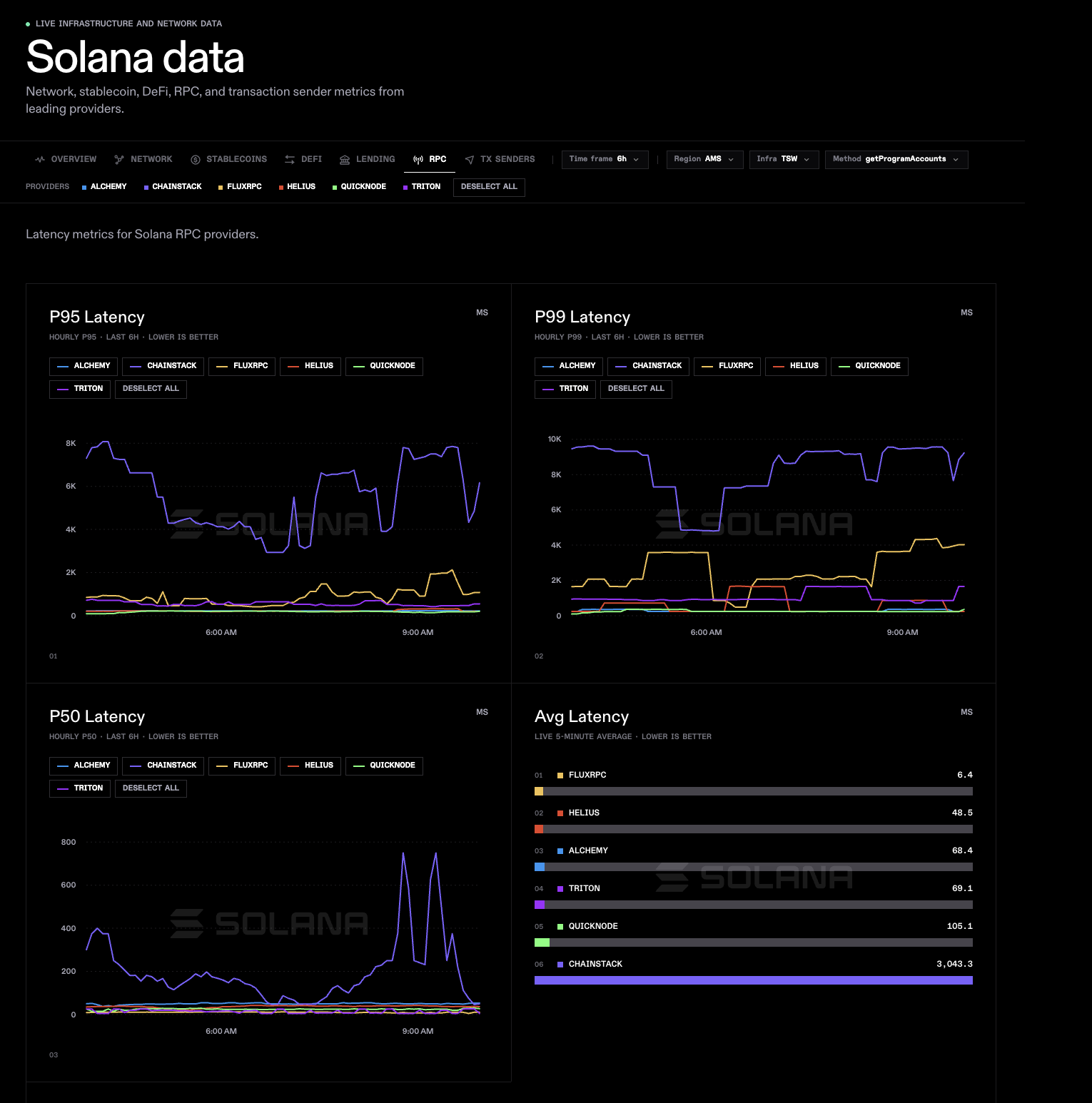
View getProgramAccounts on the Solana data dashboard
Reading the median chart: Chainstack sets the 800 ms scale, with two peaks near 750 ms. The other five providers sit in a band below 50 ms, so this chart does not distinguish their medians precisely.
For program scans, indexers and token dashboards, the captured average puts FluxRPC first. FluxRPC also offers streaming getProgramAccounts and changedSinceSlot. Those capabilities are not measured in this view.
getBlock (recent): FluxRPC at 7.9 ms
FluxRPC averaged 7.9 ms, followed by Helius at 19.6 ms. Chainstack and QuickNode followed at 30.1 ms and 37.5 ms. FluxRPC also occupies the lowest band in the captured median panel.
| Provider | Average, ms Live 5-minute value | Hourly p50, ms Approximate reading from 6-hour chart |
|---|---|---|
| FluxRPC | 7.9 | about 10, flat |
| Helius | 19.6 | about 20, flat |
| Chainstack | 30.1 | 30 to 35 |
| QuickNode | 37.5 | 30 to 35 |
| Alchemy | 75.7 | about 75, flat |
| Triton | 94.1 | 100 to 130 |
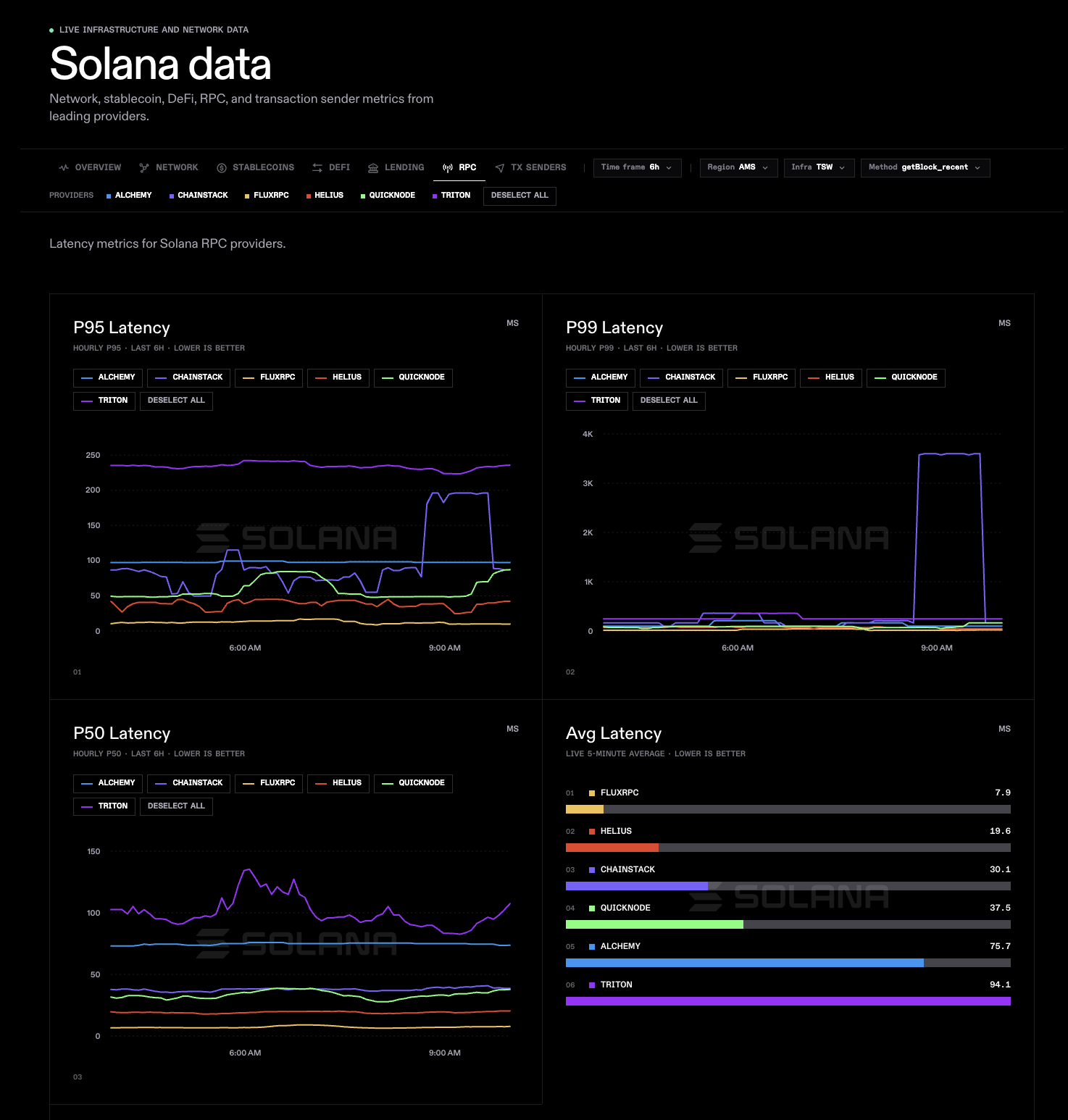
View recent getBlock on the Solana data dashboard
Reading the median chart: FluxRPC sits near 10 ms and Helius near 20 ms. Chainstack and QuickNode run around 30–35 ms, Alchemy near 75 ms, and Triton around 100–130 ms.
For recent-block ingestion into indexers and explorers, FluxRPC leads this read-latency snapshot. These figures concern recent blocks, not an archival-data or transaction-landing comparison.
getTokenAccountsByOwner: FluxRPC at 6.9 ms
FluxRPC averaged 6.9 ms, followed by Triton at 13.7 ms and QuickNode at 16.9 ms. Helius averaged 45.0 ms and Alchemy 51.7 ms. FluxRPC’s average was about half Triton’s.
| Provider | Average, ms Live 5-minute value | Hourly p50, ms Approximate reading from 6-hour chart |
|---|---|---|
| FluxRPC | 6.9 | 0 to 100 |
| Triton | 13.7 | 0 to 100 |
| QuickNode | 16.9 | 0 to 100 |
| Chainstack | 28.9 | about 600 at open, then 50 to 200, spike to about 2,000 near 9:00 AM |
| Helius | 45.0 | 0 to 100 |
| Alchemy | 51.7 | 0 to 100 |
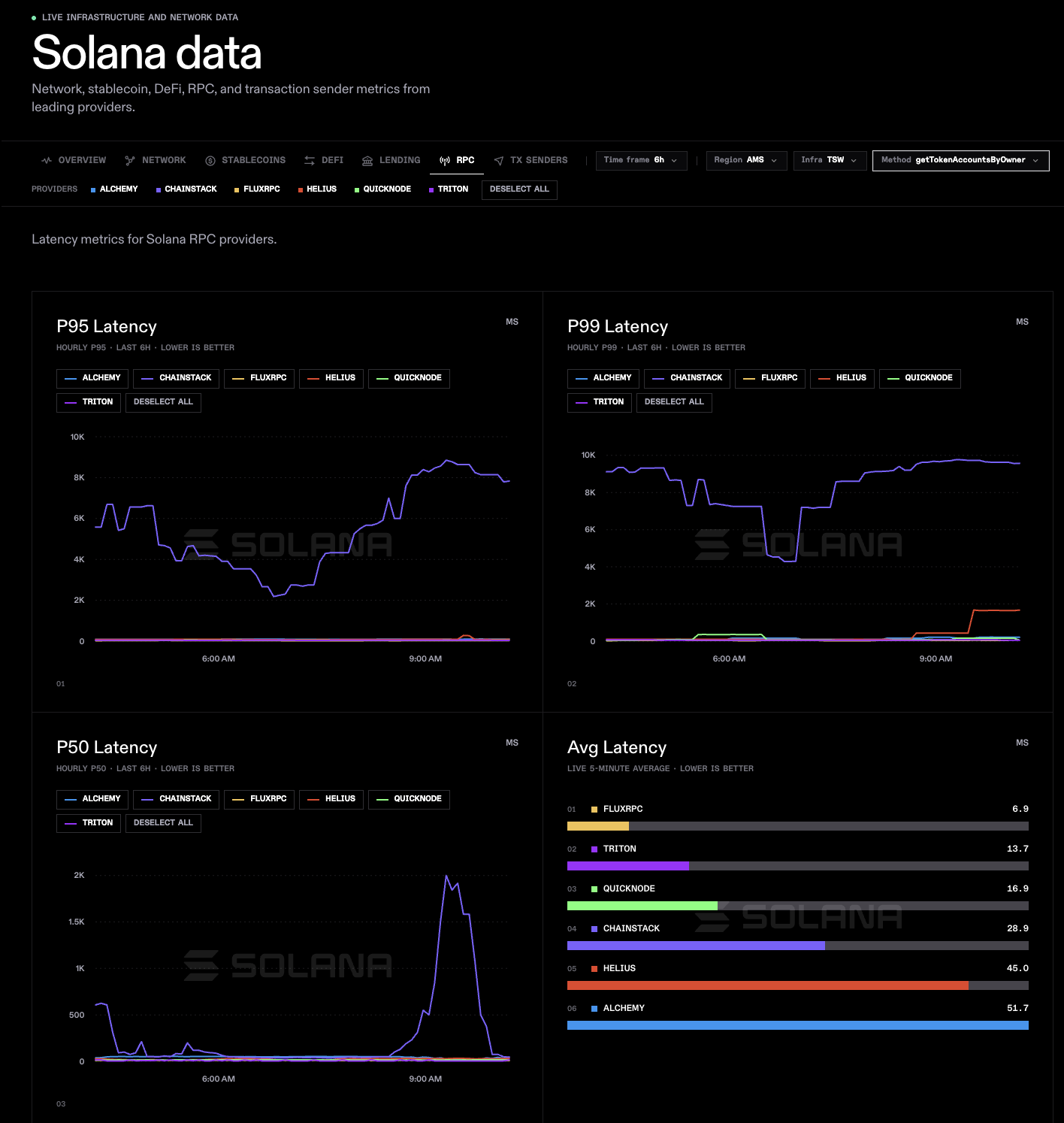
View getTokenAccountsByOwner on the Solana data dashboard
Reading the median chart: Chainstack drives the scale, with an opening value around 600 ms and a peak near 2,000 ms. The other five providers occupy a band below 100 ms; use the labelled averages for their captured order.
For wallets and portfolio applications retrieving token accounts, FluxRPC leads the captured average. Triton and QuickNode follow, while Chainstack, Helius and Alchemy record higher averages in this view.
getTransaction (recent): FluxRPC at 1.4 ms
FluxRPC recorded the lowest absolute average in the comparison: 1.4 ms. Triton followed at 5.9 ms, QuickNode at 6.3 ms and Helius at 6.7 ms. Triton’s average was about 4.2 times FluxRPC’s.
| Provider | Average, ms Live 5-minute value | Hourly p50, ms Approximate reading from 6-hour chart |
|---|---|---|
| FluxRPC | 1.4 | about 1.5, flat |
| Triton | 5.9 | about 2.5 to 3, flat |
| QuickNode | 6.3 | 7 to 8 |
| Helius | 6.7 | about 6.5, flat |
| Chainstack | 12.1 | 10 to 12 |
| Alchemy | 17.5 | 16 to 19 |
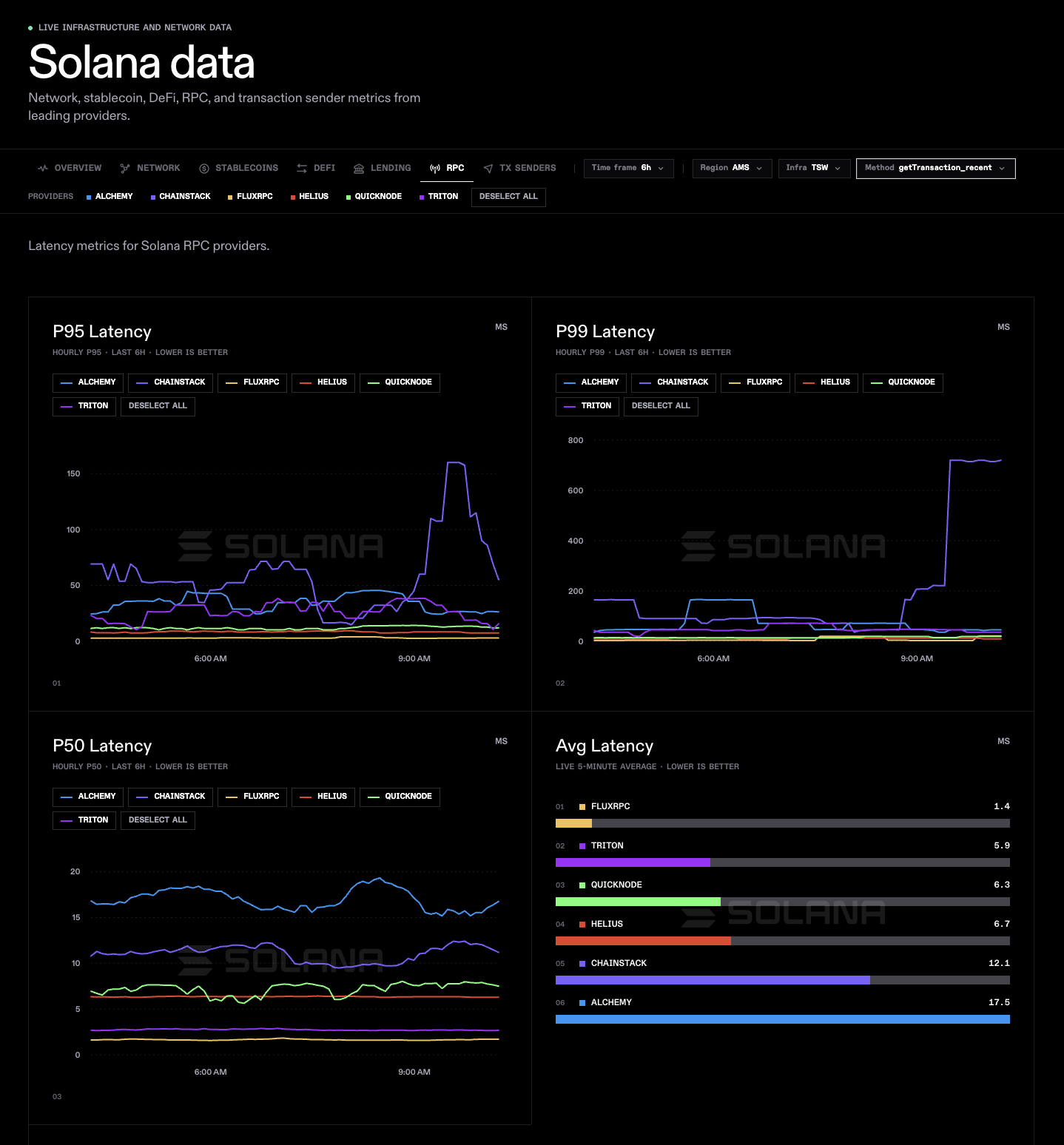
View recent getTransaction on the Solana data dashboard
Reading the median chart: FluxRPC sits near 1.5 ms, Triton around 2.5–3 ms, Helius near 6.5 ms and QuickNode around 7–8 ms. Median and live-average ordering are not identical.
Recent-transaction retrieval supports explorers and transaction-detail lookups. This result measures fetching a transaction, not how quickly a submitted transaction lands.
getSignaturesForAddress: FluxRPC at 4.2 ms
FluxRPC averaged 4.2 ms, followed by QuickNode at 12.3 ms and Helius at 13.9 ms. Chainstack averaged 648.6 ms, about 154 times FluxRPC’s figure in this snapshot.
| Provider | Average, ms Live 5-minute value | Hourly p50, ms Approximate reading from 6-hour chart |
|---|---|---|
| FluxRPC | 4.2 | under 20 |
| QuickNode | 12.3 | under 20 |
| Helius | 13.9 | under 20 |
| Alchemy | 68.0 | about 70, flat |
| Triton | 88.3 | 60 to 110 |
| Chainstack | 648.6 | 380 to 460 |
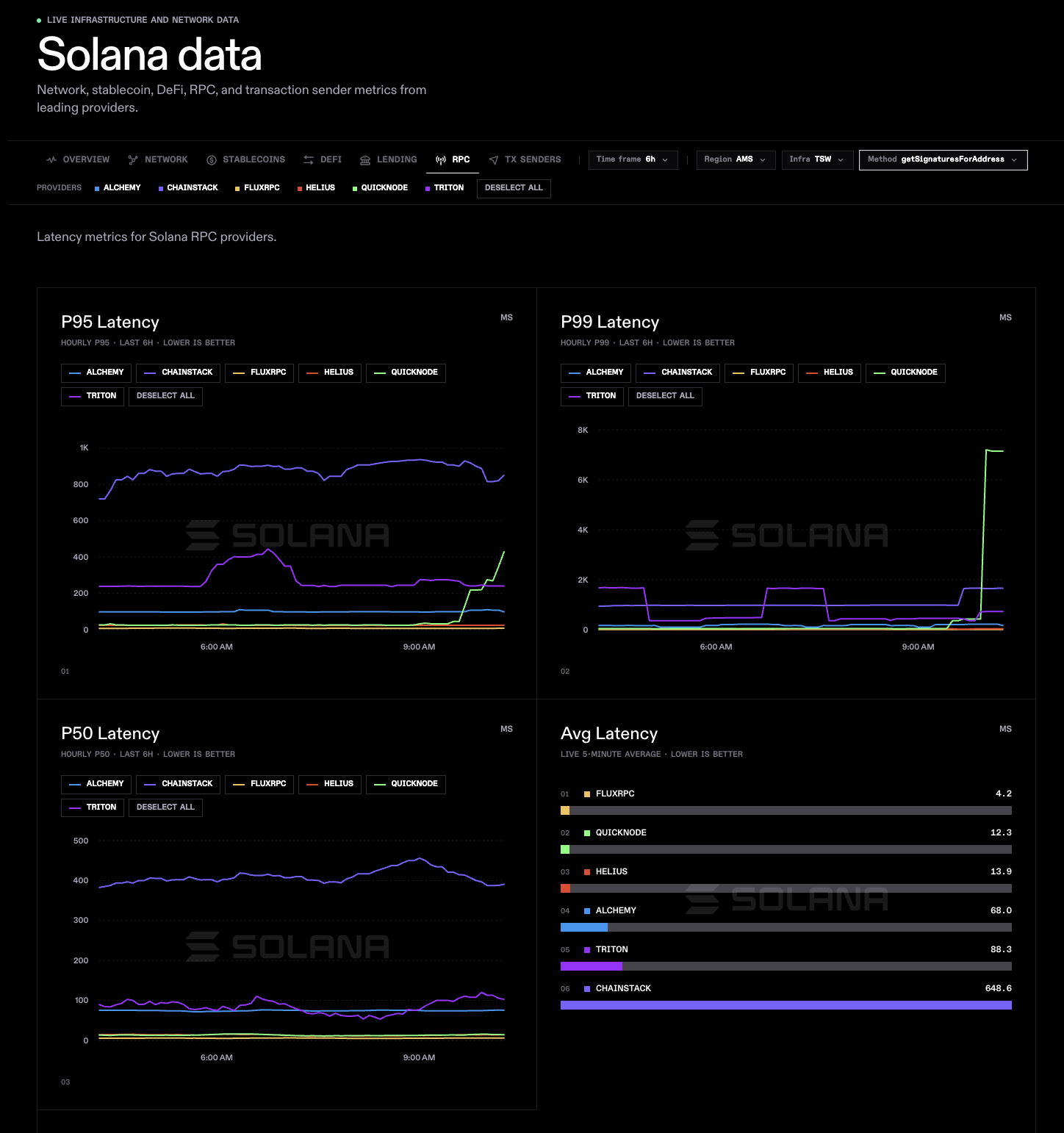
View getSignaturesForAddress on the Solana data dashboard
Reading the median chart: FluxRPC, QuickNode and Helius sit below 20 ms. Alchemy is near 70 ms, Triton varies around 60–110 ms, and Chainstack stays around 380–460 ms.
For wallet activity feeds and address-history lookups, FluxRPC leads the captured average. Repeated pagination makes per-request latency an important input to the application’s response time.
The six providers in this comparison
Read latency is the result being compared here. Product access and pricing help decide what to do with that result. Commercial details use the October 2026 reference for this article.
FluxRPC: first across all five captured averages
FluxRPC leads on every measured read method in this snapshot. Its Developer plan is listed at $38/month with 100 requests per second and 250 GB of included bandwidth. Scale is $349 with 300 requests per second and 3 TB; Pro is $849 with 750 requests per second and 15 TB. Its validator-decoupled read layer combines HTTP/3, WebSockets, webhooks and Yellowstone on paid plans.
Lantern is FluxRPC’s self-hosted Solana account-state cache. It keeps selected data synchronized beside your application and serves supported reads locally, alongside hosted RPC. That adds a local account-read option to FluxRPC’s plan-based bandwidth model.
Helius: second on program accounts and recent blocks
Helius is second on getProgramAccounts at 48.5 ms and recent getBlock at 19.6 ms. It is fifth on getTokenAccountsByOwner at 45.0 ms. Its Solana-specific APIs include DAS, enhanced transactions, webhooks, Sender and LaserStream. The $49 entry plan does not include mainnet LaserStream; that access begins on Business at $499/month in this pricing reference.
QuickNode: second on address signatures
QuickNode is second on getSignaturesForAddress at 12.3 ms, and third on both getTokenAccountsByOwner and recent getTransaction. Its wider offer is a multi-chain platform with marketplace add-ons and credit-based Solana usage. It does not take first place on any of these five captured averages.
Alchemy: third on program accounts
Alchemy averages 68.4 ms on getProgramAccounts, placing third in that view. It is fifth on recent blocks, fourth on address signatures and sixth on both recent transactions and token accounts by owner. Its wider offering is a multi-chain developer platform using compute-unit billing.
Triton: second on token accounts and recent transactions
Triton is second on getTokenAccountsByOwner at 13.7 ms and recent getTransaction at 5.9 ms, but sixth on recent getBlock at 94.1 ms. Triton created Project Yellowstone. Its entry arrangement uses a $125 prepaid deposit with per-call standard-RPC usage. These HTTP read results are separate from its streaming and transaction-delivery products.
Chainstack: the largest averages on two methods
Chainstack averages 3,043.3 ms on getProgramAccounts and 648.6 ms on getSignaturesForAddress, the highest values in those captured views. Its recent-block average is 30.1 ms, placing third. The screenshots also show substantial percentile spikes on selected methods. The result is method-specific, not a claim that every Chainstack operation behaves the same way.
Fast Solana RPC reads, without a separate per-call bill
FluxRPC recorded the lowest average latency across all five methods in the October 20 Amsterdam capture. But response time is only part of the buying decision. Applications also need to know what those reads will cost as usage grows.
FluxRPC combines those read results with a regular $38/month Developer plan, 250 GB of included bandwidth and no separate standard-RPC per-call fee. Use the included bandwidth first, then purchase additional bandwidth at $0.06 per GB or upgrade.
What does a production workload cost each month?
Our published pricing comparison applies the same production request mix to FluxRPC, Helius and Triton:
| Monthly RPC requests | FluxRPC Developer Plan + extra bandwidth | Helius Developer Plan + extra credits | Triton Requests + bandwidth |
|---|---|---|---|
| 10 million | $38.00 | $58.75 | $106.38 |
| 100 million | $70.88 | $596.50 | $1,063.84 |
Monthly estimates use the separate FluxRPC production sample from September 19–October 5, with the selected plan fees included and traffic within the applicable limits. They exclude streaming, taxes and purchase increments. Triton’s figures are usage charges deducted from prepaid credit. The October 20 dashboard supplies the latency results, not these cost estimates.
At 100 million monthly requests in this model, FluxRPC saves $525.62 against Helius Developer and $992.96 against Triton. The advantage comes from how requests consume the allowance, not merely from a lower starting subscription.
Full workload and calculations: Solana RPC pricing: FluxRPC vs Helius vs Triton
Why repeated reads cost less on FluxRPC in this workload
Triton charges for standard RPC requests and the data returned. Its published rate is $10 per million calls plus $0.08 per GB. At 100 million requests, the call charge alone is $1,000 before bandwidth. FluxRPC has no equivalent standard-RPC call charge. Triton’s bandwidth rate is also 33.3% higher than FluxRPC’s $0.06 per additional GB.
Helius deducts credits according to the method. Most standard calls consume one credit, while standard getProgramAccounts consumes ten. FluxRPC does not apply a method-credit multiplier: the returned data consumes the plan’s bandwidth allowance.
For applications making frequent, small reads, that difference matters. More requests do not automatically mean proportionally more data, yet a per-call or method-credit model still charges against the request count.
Match the workload to both latency and cost
| Application workload | FluxRPC captured average latency | What matters financially |
|---|---|---|
Recent transaction lookups
getTransaction | 1.4 ms | Repeated lookups consume bandwidth without a separate FluxRPC call fee. |
Wallet activity and address history
getSignaturesForAddress | 4.2 ms | Additional pages and refreshes add returned data, not a separate per-call charge. |
Wallet and portfolio balances
getTokenAccountsByOwner | 6.9 ms | The allowance is consumed by the data returned, rather than a method-credit deduction. |
Program scans and token analysis
getProgramAccounts | 6.4 ms | FluxRPC has no method-credit multiplier. Standard GPA consumes ten credits per call on Helius. |
Recent block ingestion
getBlock | 7.9 ms | Block size drives bandwidth consumption. Budget the returned data alongside request volume. |
Latency: captured live five-minute averages, Amsterdam, TSW infrastructure filter, October 20, 2026. Billing: FluxRPC’s plan-based bandwidth model and the method-credit rules used in the published pricing comparison.
The case for FluxRPC is speed and operating cost together: the lowest captured average on all five read methods, lower estimated monthly charges for the published production mix, and no separate standard-RPC per-call fee.
Mainnet Yellowstone from $38, with lower bandwidth charges
FluxRPC includes mainnet Yellowstone gRPC, hosted Solana RPC and 250 GB of bandwidth on its regular $38/month Developer plan. Helius mainnet LaserStream starts at $499/month, making FluxRPC’s monthly entry price $461 lower.
Triton also charges more for bandwidth: $0.08 per GB versus FluxRPC’s $0.06 per additional GB. That makes Triton’s published bandwidth rate 33.3% higher. With FluxRPC, you use the bandwidth included in your plan first, then purchase additional data or upgrade. Triton starts with a $125 prepaid usage deposit.
For applications combining streaming with standard RPC reads, FluxRPC has no separate standard-RPC per-call fee. Triton adds $10 per million standard RPC calls on top of bandwidth. Its streaming-only rate is $0.08 per GB without the standard-RPC call charge.
Explore FluxRPC Yellowstone streaming
Start with RPC and mainnet streaming in one FluxRPC plan. Use the included bandwidth, then scale your data allowance as your application grows.
Frequently asked questions
Which Solana RPC provider was fastest in this comparison?
FluxRPC had the lowest live-average latency on all five methods captured from Amsterdam on October 20, 2026. Its averages were 6.4 ms for getProgramAccounts, 7.9 ms for recent getBlock, 6.9 ms for getTokenAccountsByOwner, 1.4 ms for recent getTransaction and 4.2 ms for getSignaturesForAddress.
Where can I see the Solana RPC benchmark?
Open the Solana Foundation data dashboard and select RPC, AMS, TSW and the method you want to inspect. The links under each image open the corresponding view. Use the six-hour time frame to match the chart setting; the live values will change.
Are the average and p50 results the same measurement?
No. The averages in the tables are the values printed in the live five-minute average panel. The p50 values are approximate readings of the hourly median chart over six hours. The ordering can differ, and overlapping median lines do not support a precise rank from the chart alone.
Which provider should I use for account-heavy applications?
FluxRPC leads the captured averages for program-account scans, token-account retrieval and address-history reads. Its plan-based bandwidth model and Lantern local account-state cache provide additional reasons to evaluate it for read-heavy applications. The dashboard results do not measure Lantern itself.
Does FluxRPC charge a per-call fee?
No. Standard RPC requests use the bandwidth included in your FluxRPC plan. Once that allowance is consumed, purchase additional bandwidth at $6 per 100 GB or upgrade. There is no separate standard-RPC per-call charge.
Can I use FluxRPC alongside another provider?
Yes. FluxRPC’s validator-decoupled read layer and separate infrastructure are relevant to a multi-provider design. Compare the dependencies of the two services as well as their interfaces; a second provider name alone does not establish a different failure path.
Will these benchmark figures change?
Yes. The dashboard is live, while this article preserves the October 20, 2026 captures. Compare the same method, region, infrastructure filter and statistic when reading a later result.
Get started with FluxRPC
Start with the provider that led all five captured read averages. FluxRPC Developer combines hosted Solana RPC with Yellowstone access, 250 GB of included bandwidth and 100 requests per second at the regular $38/month price used in this article. Higher plans provide larger allowances and request limits.
Connect your application to FluxRPC for hosted reads. Use Yellowstone for live updates and Lantern for synchronized local account-state reads. The results combine a clear buying case: the lowest captured averages across all five methods, competitive workload costs and no separate standard-RPC per-call fee.
Get started with FluxRPC | View FluxRPC plans | Connect your application